Exposure Triangle
Modified 2025-12-05
The ISO, shutter speed, and aperture all effect the exposure of an image, but they all come with their own unique creative controls. The main thing I like about having the camera in manual mode is two-fold. I can 100% blame myself for the wrong exposure, and I want to learn to control these quite fast so I can operate it based on muscle memory.
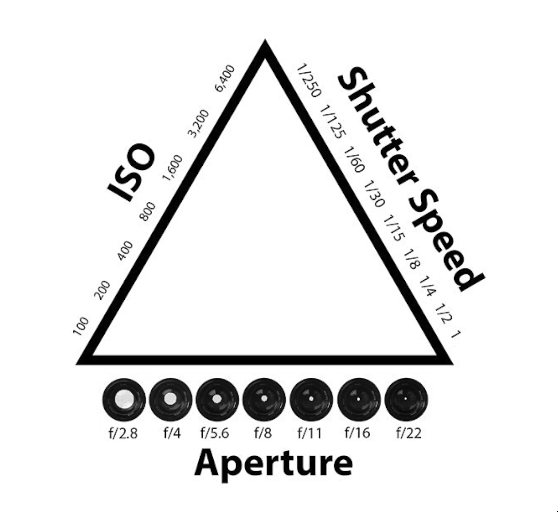
If you don't consider creative controls, then we can communicate between these 3 numbers using stops of light. Adding (removing) one stop of light, doubles (halves) the exposure. I think the knobs on the X-T5 operate on per stop increments.
The camera has an idea of the "correct" exposure by averaging the amount of light in the scene (on a grey scale) and spits out a number. *The perfect exposure for the camera might not be the correct exposure for your creative control.* Usually, when shooting shadows you will be under-exposing, while creating an airy mystical image might work better by over-exposing.
The workflow is shutter speed, then aperture, and lastly ISO. What shutter speed do I need to freeze the action, or blur the subject? Is the subject in focus, enough depth of field, do I need bokeh? What kind of grain does the image need, or can I just up the ISO to increase the light if needed?
Shutter Speed
For freezing the frame, a 1x-3x the focal length of your lens. So, for a XF 50mm f2 from Fuji, which is an APS-C means lowest should be 1/75s (full-frame equivalent) for landscape photography.
Lazy or long-exposure pictures really depend on what the creative goal is, for example a slight blur in street photography could be 1/30s. Or use a tripod for long-exposures, like water or lights (even 30s long exposures). Panning is an advanced technique, because you have to track the subject.
Or use it when you need less/more light if Aperture and ISO are set.
Aperture
Formula: f-number = focal length / diameter of aperture
- f2 is wide open, lots of bookeh, shallow depth of field, used in portrait and low light
- f11 narrow, deep depth of field, used in landscapes and daylight
ISO
Increases the gain, or sensitivity of the sensor. Modern ISO is quite good though, for APS-C workable maximum around 6400 ISO. Mainly used to adjust the exposure, but the X-T5 needs a non-mininum ISO to get a higher dynamic range.